
AEO vs GEO vs LLMO: What Is the Difference?
AEO, GEO, and LLMO explained in plain language. What each term means, how they differ, when to prioritize each, and how to cover all three as layers of one AI visibility strategy.
 Sebastian Kraus
AEO focuses on getting your content selected as a direct answer. GEO focuses on being included or cited in AI-generated search responses. LLMO focuses on making your content and brand entities easier for large language models to understand, retrieve, and recommend. In practice they overlap heavily, so treat them as three layers of one AI visibility strategy rather than separate channels.
If you only remember one thing: AEO makes your answer extractable, GEO makes your content cite-worthy, and LLMO makes your brand understandable to AI systems.
Quick Comparison
| Term | Full Name | Main Goal | Best For | Main Tactics |
|---|---|---|---|---|
| AEO | Answer Engine Optimization | Become the direct answer | Featured snippets, voice search, AI answer boxes | Clear definitions, FAQ blocks, concise answers |
| GEO | Generative Engine Optimization | Be cited or included in AI-generated responses | Google AI Overviews, Perplexity, ChatGPT search | Source-worthy content, evidence, citations, and topical authority |
| LLMO | Large Language Model Optimization | Help models understand and recommend your entity | Brand recall, entity clarity, AI assistant visibility | Consistent entity data, structured content, third-party mentions |
The rest of this guide defines each term in plain language, then breaks down where they differ, when to prioritize each, and how to measure them realistically.
What Is AEO?
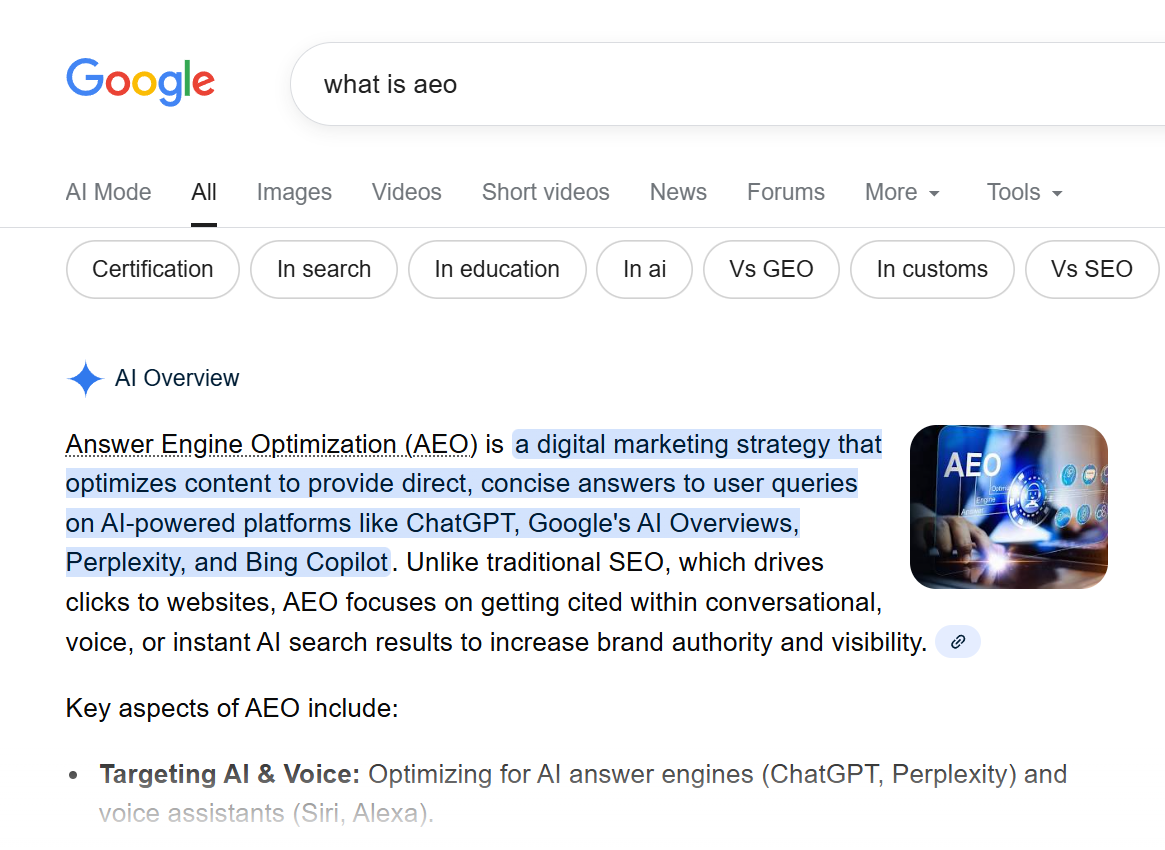
A Google result showing a featured answer box for "What is AEO?" (Answer Engine Optimization).
Answer Engine Optimization (AEO) is about making your content the quick, direct answer a search platform can lift and display. Instead of optimizing only to rank a link, you format the content so an engine can extract a clean response. Search "What is AEO?" and you often see a featured snippet box with a concise definition brainz.digital.
AEO is closely tied to featured snippets, "People Also Ask," and voice answers. These are the surfaces that read a short answer aloud or show it above the links. To win there, write in an answer-first style with clear headings, lists, and FAQs so engines can grab and display your answer easily brainz.digital.
A reliable format for AEO content:
- Question as the heading (matching how people actually ask it)
- A 40 to 60 word answer immediately below, with no preamble
- Supporting detail afterward for readers who want depth
What Is GEO?
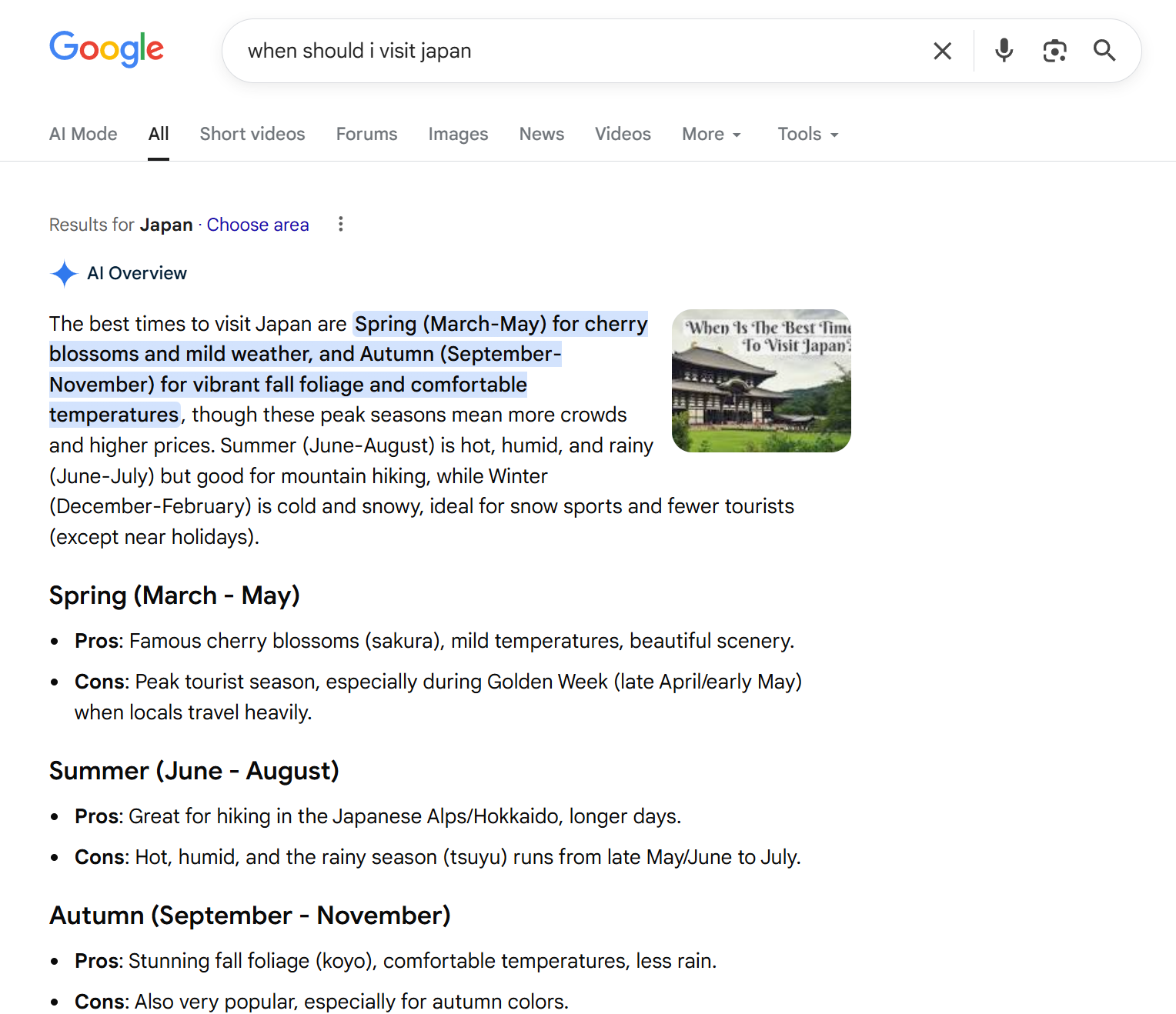
Google's AI Overview for "When should I visit Japan?", a generative summary that pulls from multiple sources.
Generative Engine Optimization (GEO) is about being included and cited when an AI system synthesizes an answer from many sources. Generative engines like Google's AI Overviews, Perplexity, and ChatGPT search don't just rank pages. They read across multiple pages and compose a new answer, often with citations. GEO is the work of making your page one of the sources that answer is built from directiveconsulting.com.
The key shift from classic SEO: GEO is about visibility inside a generated answer, not only ranking a page on a results list. You can be cited in an AI Overview without holding the top blue link, and you can rank well yet never get pulled into the summary.
What makes content cite-worthy for GEO:
- Evidence and specifics: original data, examples, and clear claims an engine can quote
- Citations and sourcing of your own, which signal credibility
- Topical authority: depth across a subject, not one thin page
- Freshness on topics where recency matters
What Is LLMO?
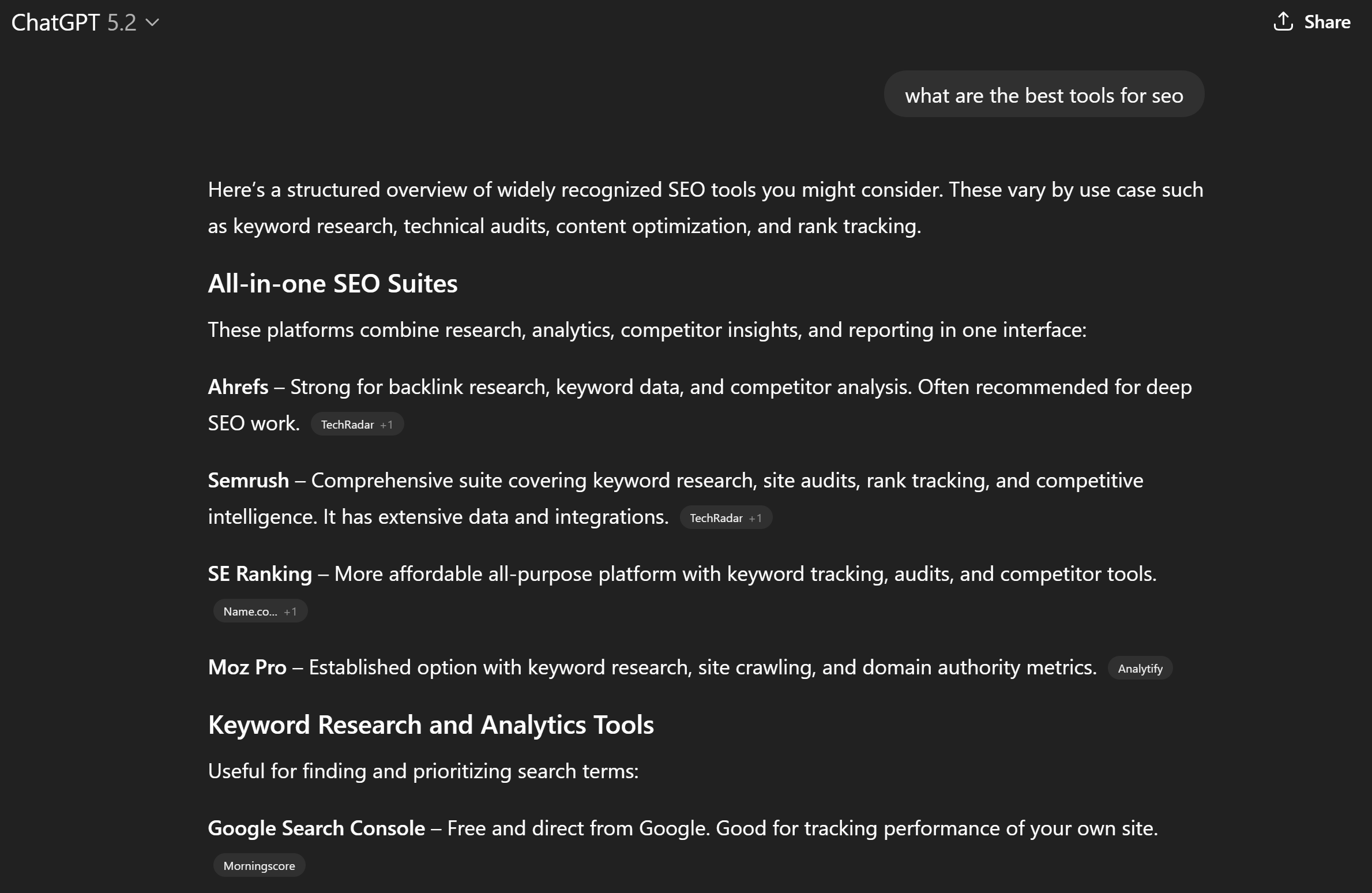
A ChatGPT answer listing recommended SEO tools and citing sources.
Large Language Model Optimization (LLMO) is the most technical and least standardized of the three. It's about helping language models understand and retrieve your entity (your brand, products, and people) so they describe you accurately and surface you in recommendations. Ask ChatGPT "What are the best tools for SEO?" and LLMO is the work behind being one of the names it returns.
Because the field is young, be careful not to overclaim: there is no guaranteed lever that forces a model to mention you. LLMO is about raising the odds, and it rests on a few durable ideas:
- Entity clarity: an unambiguous, consistent definition of who you are and what you do
- Content retrievability: clean structure and schema so machines can parse your pages
- Consistency everywhere: the same names, descriptions, and facts across your site, social profiles, reviews, directories, and third-party mentions
promarketer.ca
Models cross-check many sources at once. If your brand story or product names differ from page to page, the model gets a fuzzier picture and is less likely to recommend you confidently.
AEO vs GEO vs LLMO: Key Differences
The three overlap, but they optimize for different things:
| Dimension | AEO | GEO | LLMO |
|---|---|---|---|
| Goal | Be the direct answer | Be cited in a generated answer | Be understood and recommended |
| Search surface | Snippets, voice, answer boxes | AI Overviews, Perplexity, ChatGPT search | AI assistants and chatbots |
| Content format | Concise, extractable answers | In-depth, evidenced, sourced | Structured, consistent entity data |
| Trust signals | Clarity and exact-match phrasing | Evidence, citations, authority | Entity consistency, third-party mentions |
| Measurement | Snippet / PAA visibility | Citation frequency, AI referrals | Brand accuracy in AI answers |
| Best use case | Defining and how-to queries | Research and comparison queries | Brand and recommendation queries |
How They Work Together
These aren't rival strategies. They're layers of one approach:
AEO makes answers extractable. GEO makes content cite-worthy. LLMO makes entities understandable. Together, they improve AI visibility across search results, AI summaries, and conversational assistants.
In practice the tactics reinforce each other. Writing a clear answer-first section (AEO) also makes your content easier for generative engines to pull from blog.hubspot.com. Adding evidence and citations (GEO) makes models more likely to trust and quote you
directiveconsulting.com. And keeping your entity data consistent (LLMO) helps every system attribute the information back to you
promarketer.ca. One strong content strategy can serve all three at once
neilpatel.com.
Which One Should You Prioritize?
You rarely have to pick exclusively, but your starting point depends on your goal and resources:
| Situation | Priority |
|---|---|
| You want featured snippets | AEO |
| You want visibility in AI summaries | GEO |
| Your brand is misunderstood or absent in AI tools | LLMO |
| You're building a full AI search strategy | Use all three |
| You have limited resources | Start with AEO and GEO |
AEO and GEO are the fastest to influence because they're driven by content you publish. LLMO is more of a long game, paying off as consistent signals accumulate across the web.
Practical Optimization Checklist
A sharper, do-this list that serves all three layers:
- Add concise answer blocks near the top of each page (40 to 60 words)
- Use comparison tables to structure differences and options clearly
- Include original examples or data an engine can quote
- Cite credible sources to signal trustworthiness
- Make author and brand expertise explicit (bios, credentials, about pages)
- Use descriptive, question-shaped headings
- Add FAQ sections to capture long-tail questions
- Strengthen internal links so crawlers and models see topical depth
- Keep entity names consistent across your site, profiles, and directories
- Add structured data (Organization, Person, Product, FAQ) so machines can parse you
- Track citations, mentions, rankings, and AI referral traffic
Common Misunderstandings
- They don't replace SEO. AEO, GEO, and LLMO build on top of solid SEO fundamentals: a fast, crawlable, well-linked site
neilpatel.com.
- The terms overlap. The lines between them are fuzzy, and different sources draw them slightly differently. Don't get lost in taxonomy. Focus on the underlying tactics.
- You can't force a citation. There's no guaranteed way to make an AI system quote or recommend you. You improve your odds; you don't buy a slot.
- Schema alone isn't enough. Structured data helps machines parse your content, but it can't make up for thin or low-authority pages.
- More content isn't better unless each page adds genuine value. Volume without quality dilutes your topical authority.
How to Measure Success
Be realistic about what's trackable. Some of this is well-instrumented; some is still emerging:
| Area | Metrics |
|---|---|
| AEO | Featured snippet wins, "People Also Ask" visibility, direct-answer inclusion |
| GEO | AI citation frequency, mentions in AI search tools, AI referral traffic |
| LLMO | Brand accuracy in AI answers, entity consistency, third-party source presence |
| SEO foundation | Rankings, impressions, clicks, backlinks, engagement |
AEO and SEO metrics are the most mature. GEO and LLMO measurement is improving but still partly qualitative, so expect to combine analytics with manual spot-checks of how AI tools describe and cite you.
The Road Ahead
The surfaces will keep changing, with new AI search products, new citation formats, and new assistants arriving all the time. But the fundamentals behind AEO, GEO, and LLMO are stable: give clear answers, earn trust with evidence, and keep your brand legible to machines. Optimize for those principles and you stay resilient as the specific tools evolve.
FAQ
Is GEO the same as AEO? No. AEO aims to be the single direct answer (a snippet or voice response). GEO aims to be included or cited when an AI system synthesizes an answer from many sources. They overlap but optimize for different surfaces.
Is LLMO replacing SEO? No. LLMO sits on top of SEO. If your site isn't crawlable, fast, and well-structured, models struggle to understand and retrieve it in the first place.
Which is most important right now? It depends on your goal. For defining and how-to queries, AEO. For research and comparison queries appearing in AI Overviews, GEO. For brand recognition in AI assistants, LLMO. Most teams benefit from all three.
Can small brands win in AI search? Yes. Clear, well-structured, genuinely useful content can be cited regardless of brand size. Consistent entity data and topical focus matter more than budget here.
How do you optimize for ChatGPT or Perplexity? Publish source-worthy content with evidence and clear structure, keep your entity information consistent across the web, and earn third-party mentions. These tools favor content they can trust and attribute.
Does schema help with AEO, GEO, or LLMO? It helps all three by making your content machine-readable, but it's a supporting signal, not a standalone tactic. Pair it with strong, well-structured content.
How do you track AI search visibility? Combine analytics (AI referral traffic, rankings, impressions) with manual checks: query the major AI tools for your topics and brand, and record whether you're cited, mentioned, or described accurately.
Sources
brainz.digitalhttps://www.brainz.digital/blog/what-is-aeo/
directiveconsulting.comhttps://directiveconsulting.com/blog/what-is-generative-engine-optimization/
blog.hubspot.comhttps://blog.hubspot.com/marketing/answer-engine-optimization-trends
Written by

Founder of VecDoor, passionate about AI visibility and generative engine optimization. With a background in AI and digital marketing, Sebastian helps businesses adapt their online presence for the age of AI-powered search. He shares insights on how to optimize content for AI models and stay visible in an evolving digital landscape.